Sunday, June 5, 2022

If I Were on The Late Show with Stephen Colbert

[This is a post in a series.  You may wish to read the introduction to the series.  Like all my series, it is not necessarily contiguous—that is, I don’t guarantee that the next post in the series will be next week.  Just that I will eventually finish it, someday.  Unless I get hit by a bus.]


There is so much I want to know, there’s so many depths that I want to plum with my questioning, and yet there is no time.  So the scientists in the Late Show Labs came up with 15 questions, at the end of which, should you choose to accept the challenge of what has been called “The Colbert Questionert,” you will be fully known.
Stephen Colbert

The “Colbert Questionert” (pronounced “questionnaire,” to rhyme with “Colbert”) is a newer segment of Stephen Colbert’s show: while The Late Show with Stephen Colbert has been around since 2015, the Colbert Questionert debuted just last year, with Tom Hanks being the inaugural celebrity (in Janurary of 2021).  Since then, 23 more celebrities have taken it, and it seems like he’s just getting started.

The structure of the questions is obviously a humourous take on the Pivot Questionnaire used by James Lipton, and perhaps is even an homage to it.  While many of the questions are designed to be silly, some are fairly penetrating, if occasionally in a roundabout way.  Here, then, are my answers—longer than most of Colbert’s guests, but at least shorter than Jeff Goldblum’s.  (Note: This is the original, slightly longer, version of the Questionert.  Later interviews have dropped questions #10 and #11.  But that leaves 13 questions, so ... yeah, I’m not doing that.)


The Colbert Questionert

  • What is the best sandwich?

Well, if it has to be a sandwich sandwich, then I have to go with a turkey club.  Gotta have 3 layers, gotta have bacon and tomato (which is weird, because normally I don’t care for tomato), lots of mayo, lettuce optional.  But if a sub counts as a sandwich, then I’m all about the Italian cold cuts sub, but I’m very precise when it comes to ingredients.

First of all, salami and pepperoni are a given.  I have very occasionnally come across a sub billed as “Italian” with no pepperoni in it, and my first thought is, where do they get the balls?  Hard salami works better than Genoa, in my opinion.  Next comes the ham.  Now, the vast majority of “Italian” subs come with regular old deli ham on them, and deli ham is barely ham at all, much less Italian.  It’s 100% American, and it’s about a half step up from Spam.  So why on earth would you put that on an Italian sub?  No, an Italian sub needs an Italian ham, and, while for some folks that means prosciutto, I like to buck the trend: I prefer capocollo.  It’s hard to come by in the US, so you definitely want an Italian sub made with it when you can get one.  Finally, espeically if you’re using a hard salami, you need a softer meat to go along with all the harder salumi.  Now, most “proper” Italian subs will use mortadella for this purpose.  And it’s a fine choice, if that’s all you can get.  But, realistically, mortadella is too fatty for this application.  Honestly, just use a decent bologna.  Real Italian bologna is actually really good, and the fact that we think of the Oscar-Mayer version as cheap fodder for kids’ lunchboxes shouldn’t reflect on the proud heritage of the Bolognese people.

Toppings-wise, I like a little olive oil but no vinegar; lots of mayo; lettuce and onions; and salt, pepper, and oregano.  Mmmm ... I’m getting hungry just writing this up.

  • What’s one thing you own that you really should throw out?

Out of all the questions, this one is probably the hardest one for me.  I mean, I have a lot of shit that one could make an argument that I should throw out: I still have over 500 CDs sitting right next to me, in spite of the fact that they’ve all been digitized and I never even take them out of the cases any more.  I have way too many of a lot of things: books, fantasy miniatures, old computer equipment.  But none of it do I ever look at and say “I should really throw that out.”

I think the best I can do is the “bar.” Once upon a time, when I was in college (for the second time), there was a party house that we used to go to that was owned (or more likely rented) by three college girls, and they had the coolest, raddest bar in the world.  It was an actual piece of furniture, perfect height, sturdy wood construction, and it could hold a metric shit-ton of liquor.  Then those ladies moved out and broke up their house, and they offered us the bar, because they knew we sometimes threw parties, and they didn’t want to see it go to waste.  So then our house became the party house, and the bar was a big part of the draw.  I dragged that stupid bard with me across three or four different roommmate houses, even to a couple of the offices for my company Barefoot Software.  Then I made eBay pay to haul it across the country, from DC to LA, where it now sits underneath my TV, full of DVDs that we also hardly ever take out of the case.  Needless to say, at this point, it’s looking pretty bedraggled (chipped corners and whatnot), and there’s so much crap piled up in front of it that you couldn’t even get to the DVDs if you wanted to most of the time.  Other than keeping the TV a nice distance up off the floor, and providing a place for the PS/4 and the Sonos soundbar and the UPS battery backup so the Internet can stay up for a while after the power goes out and all that jazz, it doesn’t serve much purpose.  But I keep it, mostly out of nostalgia.  Most likely I should just break down and buy a new piece of furniture that will serve that purpose (and probably do it much better).  And probably some day I will.  But not today.

  • What is the scariest animal?

Okay, this one is easy for me.  In general, I’m not scared of animals—I love animals.  All sorts of animals.  And, to me, most animals are easy to deal with: there are some that you just have to handle with a lot of care, and some that you just better not try to handle at all.  Animals make sense to me (often more than people do).

But I was watching TV once, and of those horribly cheesy “When Animals Attack!” shows came on.  And I thought, this should be good for a laugh.  And, sure enough, story one was a hunter who, when he came face-to-face with a grizzly bear, turned and ran.  Idiot.  Story two was an African guide who let his clients bully him into getting “just a little bit closer” to a group of hippos.  This guy even came out and said that he knew better.  Story three was a guy who, while out hiking on a beach, decided to go take a swim.  In 10 feet of water.  In Australia.  The only reason the sharks didn’t eat him was that the crocodiles got to him first.  And then came the last story: a guy in California (you know: the place where I live) was jogging down a highway, and stopped to drink some water.  And got attacked by a mountain lion.  Not doing anything, mind you: not encroaching on the cougar’s territory, not ignoring advice about what to do when confronted with one, just miding his own damned business on the side of a friggin’ highway, leaning against a rock, and blam! mauled by a puma.  That was chilling to me.

I mean, the standard advice for mountain lions is to use your clothes to make yourself appear bigger.  But he literally had no time: one second he was like, what the fuck? is that a puma? and the next second he was getting his arm chewed off.  If he hadn’t managed to stab it in the neck with ... something or other, something that no doubt didn’t do much actual damage to the cougar, just enough to make it think twice about this being an easy meal ... if he hadn’t managed to to that, he’d have been one dead dude.  Now that’s scary.

  • Apples or oranges?

Oranges.  Which is typically the place where Stephen would point out that you can’t put peanut butter on an orange.  Which is true, but you also can’t bite into an apple slice and have orange juice squirt out.  So, you know: trade-offs.

  • Have you ever asked someone for their autograph?

The draw of this question is that the person answering is themselves a celebrity, so it’s interesting to hear who a famous person thought was so awesome that they wanted to get an autograph.  So poor little unknown me can’t possibly be nearly so interesting, even if I had a cool answer.  But, sadly, I do not: I’ve just never been into the idea that having someone scribble their name on a piece of paper is all that cool.  But, I dunno ... probably if I get the chance to meet of any of my pentagram of literary idols before they start to die off (or before I do), I would be hard-pressed not to ask for an autograph.

  • What do you think happens when we die?

I mean, the simplest answer is, I don’t know.  And also that I’m fine with not knowing.  Here’s a quote that I’m fond of:

There’s nothing shameful in acknowledging that you don’t have the answers to every question about life.  Just accept the fact that you know only a fraction of what’s going on in the world.  You don’t have to attach explanations in terms of a special revelation of God’s will, a glimpse at the supernatural, evidence of a conspiracy, or anything else ...
Harry Browne

In other words, it’s okay not to know.  Voltaire (supposedly) said: “Doubt is not an agreeable condition, but certainty is an absurd one.” So I’m comfortable with knowing that we can’t know, and just dreaming of possibilities.  Reincarnation is a possibility that I’m quite fond of, coming as it does with the concept of karma, which really satisfies my overblown sense of justice.  I’m also intrigued by the possiblity of ghosts, and I think it’s a little weird that we’ve culturally decided that people’s energy hanging around to talk to us after their body has perished is scary.  There’s also the possiblity that our consciousness just ceases to be and our atoms get scattered across the universe to make new matter, and I’m actually okay with that one too.  So many possibilities that are really intriguing; again, pretty weird that so many of us got hung up on this whole heaven and hell thing.

  • Favorite action movie?

Well, as I’ve talked about before, I have a list of “top X movies”: I don’t like to restrict myself to any particular number.  Of those, none are what you might call a “pure” action movie—your Die Hards, your Lethal Weapons, your John Wicks or Jason Bournes.  But several are at least half action movie, and a few are more than that.  Here’s the ones that I think could be considered action movies: The Crow, Highlander, The Matrix, Pulp Fiction, and The Road Warrior.  Now, thinking about which one I like best as an action movie, I can eliminate The Crow, Highlander, and Pulp Fiction: while they’re fantasic movies, and they have some great action scenes, I’m not watching them for the action, if you see what I mean.  And, while I’m tempted to give it to The Road Warriorwhile Mel Gibson did turn out to be an unbearable shit, George Miller’s movie is still an incredible piece of cinema, and (much like Mad Max: Fury Road) the movie isn’t very much about Max anyways—I think The Matrix wins out in the end.  While the science-fiction aspects are a big part of the draw for me, I can’t deny that many of the action set-pieces are just iconic, and still breathtaking even on my tenth-or-so watch.

  • Favorite smell?

This question (and the next) are where the influence of the Pivot Questionnaire are undeniable: Colbert just took “what sound or noise do you love?” and turned it into “favorite smell,” because ... well, because that’s funnier.  But, sure: I’ll play along.

I was fortunate enough to grow up with both my grandmothers—all four of my grandparents, really, until I lost one grandfater shortly after graduating high school—and both of them cooked.  My one grandmother was all North Carolina farm girl, cooking ham and white corn and collard greens and potatoes in all their myriad forms and “cornbread” that was really something called a hoecake.  My other grandmother didn’t cook much—she had a housekeeper for that.  But the one thing she did cook, only on special occasions, was her spaghetti.  Now, there are competing stories on where this recipe came from, from the tall tale of an Italian cook that my grandfather served with in World War II to “she just found it in Ladies’ Home Journal,” but it was essentially just a standard American spaghetti-and-meatballs (and, if you think spaghetti and meatballs is Italian, I must refer you to Alton Brown’s “American Classics” episode of Good Eats for further education).  Nothing too special about it, really, but it has to cook for what seems like forever, especially when you’re a kid knowing that you’re getting spaghetti tonight.  By the time dinner was served, my mouth would be watering like crazy.  To this day, that smell (because of course we still make it) is both enticing and nostalgic.

  • Least favorite smell?

Tough call.  In my family, I’m the designated person to deal with all undesireable bodily fluids: poop, blood, vomit, you name it.  So for the most part I’m inured to those types of smells.  I have a few food triggers, but they’re almost entirely confined to “only if there’s way too much of it” (e.g. cumin) or “only if I have to smell it for a really long time” (e.g. coffee).  A lot of pungent animal smells I have a weird fascination for, like skunk spray or crushed stinkbug—I don’t like smelling them, but I’m not repulsed either.  Even dead animal (say, if one of the cats brings us a “gift” of a dead rat or what-have-you) I consider unpleasant but bearable.  I think I may have to say dead fish: I’m not that wild about the smell of fresh fish, and the smell of a fishmarket or fishing dock, or just a beach where there’s a lot of dead fish washed up, and maybe a soupçon of rotting kelp ... that really turns my stomach.

  • Exercise: worth it?

Well ... yeees?  I mean, who’s going to take the position that exercise isn’t worth it?  Maybe that’s why this question has been dropped from the newer iteration of the Questionert.

But of course the problem with exercise is that the benefits are long-term and theoretical, while the downsides are both immediate and practical.  So I readily admit that, even though I intellectually know that exercise is very much “worth it,” I still have difficulty motivating myself to do it.  Especially in the winter.  In the summer, I can swim, and I actually like swimming, so I don’t mind doing a few laps as exercise.  But walking or biking or all that other jazz ... yeah, I admit that sometimes I’m just “nah, the couch is fine.”

  • Flat or sparkling?

This is the other question that’s been dropped, and I confess I miss it.  The most intriguing thing about it is, Colbert doesn’t specify whether he’s talking about water or wine (or I guess he might be talking about soda? but then is there really soda that’s flat on purpose?).  I always interpreted it to mean wine from when I first heard it; it was only later than it occurred to me he might mean water.  So, for wine, the answer is clear: you want frizzante.

Now, as a firm believer (and even pusher) of the theory of balance and paradox, it should come as no surprise to you that I find sparkling wines too sparkly and flat wines too flat.  If only there were a halfway point!  But of course there is: it just took me getting to my thirties (or maybe even forties) to understand enough about wines to realize it.  It’s called “frizzante,” and it means “gently sparkling,” or some say “semi-sparkling.” And, as it turns out, “gently” is just the right amout of sparkling, at least for me.

For water, it’s flat.  I don’t want bubbles in my water.

  • What is the most used app on your phone?

I mean, pre-pandemic, it would have to be Waze.  The only reason I bought a smartphone, originally—and I held out long after most of my friends already had one—was so that I’d never have to try to read another map in the car again.

Nowadays ... well, my podcast app is a strong contender.  I listen to a podcast or two nearly every single day.  Other than that ... I guess it would be Medito.

I decided I would try meditating, and an app on my phone seemed like a decent way to go, but I soon found that they all want you to sign up for something or subscribe to something.  And then I found the Medito Foundation, with their radical concept that meditation—a global human practice for literally millenia—ought to be free.  Doing some research, I found a really cool article about its founders and decided to give it a try.  Now, I have to admit: when it comes to actual meditation, I’ve pretty much been a failure.  But the app also has a “sleep” section, where they give you meditations to do to help you relax and fall asleep.  And a subsection of that is “sleep stories.” These are brilliant little vignettes which tell an actual story that still somehow manages to work in the cues that help you relax: from “everything is completely calm” to “everyone is exactly where they need to be” to out and out “you feel your whole body relax.” Some of them are mostly realistic, some of them have a slightly dreamlike quality, and some are completely fantastical.  Many of them have a few different versions, read by different readers, so you can pick the one that you like best.  I listen to one of these sleep stories almost every night, rotating through the list of the ones I like, and I rarely get to the end of it.

  • You get one song to listen to for the rest of your life.  What is it?

This is probably the biggest pain-in-the-ass question of the lot.  As of my typing this, I have over 20 thousand MP3 files under my music directory.  How am I going to pick just one?

Now, if anyone asks me what my favorite song is, I have an answer: there is one song that is exempt from my “no reuse” rule on my music mixes, and that is “Bonin’ in the Boneyard” by Fishbone.  I can’t say it’s my favorite song, but it is the one song that shows up on more of my mixes than any other, and that’s at least saying something.

But this question is not about my favorite song.  It’s about listening to one song for the rest of my life, and, as magnificent as “Bonin’ in the Boneyard” is, I can’t imagine that I wouldn’t eventually get sick of it.  Something a bit more complex is needed, something that can serve multiple purposes, can stand repeated listens and still reveal new depths.  Today, I think the best choice for that is “Lazy Calm,” by the Cocteau Twins.  It was the very first song of theirs that I ever heard, being the opening track of Victorialand, and it still has the power to immerse me in its swirling depths some 35 years later.  It has that lonely saxophone that I dig so much (provided by Richie Thomas of Dif Juz), a hypnotic bassline (weird, since they were without their longtime bassist Simon Raymonde at the time), and that ethereal guitar work and formless vocals that are the hallmark of the Cocteaus.  There’s even a long version that adds another 3 minutes to peruse, if I’m so inclined.

But if you ask me again tomorrow, I might have a totally different answer.

  • What number am I thinking of?

23.  It’s always 23.

  • Describe the rest of your life in 5 words.

First, let me say that I think the word “childish” gets a bad rap.  Once we get to be adults, we somehow imagine that we’re so much better than chidren that to be compared to them is insulting.  Pish-posh.  If more adults were like children, we’d be far better off: to be childish is to be innocent, guileless, creative, to want to play instead of to acquire power and wealth, to be trusting instead of devious.  And, if you know children who are not those things, you know children who have already started to turn into adults ... more’s the pity.  Me, I’m happy to be childish, regardless of how old I am.  So, therefore, my 5 words are:

Being childish with my children.


Next in the series is actually the one I wrote a while back: Talking with Chris Hardwick.


Sunday, May 29, 2022

Television Quest

Today I was all set to get working on my blog post, but we ended up buying a new television instead.  The old one isn’t quite dead yet, but it’s certainly showing its age.  We bought it about 15 years ago, when we first moved to Southern California.  We’ve been threatening to buy a new one for a while now, but we just kept putting it off.  But, last night, I finally broke down and signed up for Apple TV+, only to discover that our Fire TV is supposedly “too old” to install the Apple TV app.  Personally, I feel like this is just a ploy by Amazon to force us to upgrade when we don’t really need to.

But, regardless of whether it’s valid or not, we don’t have a lot of choice in the matter.  So, either we buy a new Fire TV, or we buy a different type of streaming device (like a Roku), or ... we just buy a new TV.  Because pretty much all TVs these days are “smart” TVs (just like pretty much all phones these days are smartphones), so, as long as it’s a recent enough model, it’ll be able to handle everything we need for now.  And, once the “smart” part of it becomes obsolete, we’ll just upgrade to a new Fire TV or Roku or whatever then and stave off the next upgrade for a while.  So, as long as we needed a new TV anyway, now seemed like a good time to get it.

So we did.  The new one is 7 inches bigger and about 20 pounds lighter.  But it obviously took up more space, so we had to unplug everything and rearrange everything and reroute cords and ... it took a while.  So I ran out of time to do blog posts.  So now all you get is this story about my TV instead.  Sorry.

But, next week, for sure.  Probably.


Sunday, May 22, 2022

The clock ticks life away ...

Nothing going on this week, so I’ll skip the partial post.  Tune in again next week for something more substantial, hopefully.


Sunday, May 15, 2022

Salsatic Vibrato VIII


"Jump Into My Caddy"

[This is one post in a series about my music mixes.  The series list has links to all posts in the series and also definitions of many of the terms I use.  You may wish to read the introduction for more background.  You may also want to check out the first volume in this multi-volume mix for more info on its theme.

Like all my series, it is not necessarily contiguous—that is, I don’t guarantee that the next post in the series will be next week.  Just that I will eventually finish it, someday.  Unless I get hit by a bus.]


Both Smokelit Flashback and Shadowfall Equinox have achieved sixth volumes in this series; in the unpublished category, there is only Paradoxically Sized World.  So far Salsatic Vibrato remains the only published volume VII, and only SfE can realistically challenge that on the unpbulished side.1  And now here we are at volume eight.  Of course (as I may have mentioned before), the mixes that achieve these rarified heights tend to be the ones I utilize most: Shadowfall Equinox is my primary work soundtrack, and Paradoxically Sized World is a set of music preferences I share with one of my children.  Smokelit Flashback mainly has the advantage of being the very first of the modern mixes, and it had two volumes before there was a volume I of anything else.  (And also whenever I’m feeling non-specifically weird, it’s what I reach for.)  And Salsatic Vibrato?  Well, that’s the mix I want when I’m feeling happy and I want to double-down on that feeling.  If I’m doing any sort of work (whether in my professional life or just work around the house) that doesn’t require any brainpower, SVb is the perfect accompaniment: it’s brassy, and upbeat, and just ... happy-making.

So what can we expect from this outing?  Certainly we can’t have a volume without Big Bad Voodoo Daddy (we certainly havne’t had one so far), and they’ll make their twelfth appearance here.  In the only-missed-one-volume-so-far camp, Squirrel Nut Zippers, Cherry Poppin’ Daddies, and Lou Bega are all here (SNZ for their eleventh appearance, so they’re only a bit behind BBVD).  Other returning artists include the Brian Setzer Orchestra (who have only missed two volumes so far), Joe Jackson (who returned last volume after a long absence), the Swing soundtrack, electro-swing artists Caravan Palace and Caro Emerald, infrequent contributors Madness, Oingo Boingo, and Indigo Swing, recent discoveries Tape Five, Swing Republic, and Electric Swing Circus, one more brass-funk masterpiece from Earth, Wind & Fire, and the Mighty Mighty Bosstones are back after last being seen way back on volume II.  And there’s still room for 6 first-timers.  So I would say this volume leans a bit heavily on established doctrine, but isn’t afraid to branch out into bold new directions at the same time.

And we’ll kick it off with the opener for BBVD’s all-time best album, Americana Deluxe.  Now, I’ve mined this album extensively: of its 12 tracks, I’ve used four on previous volumes of this mix, and several others are slated for other mixes.2  I haven’t used a track from it recently, though, and I really wanted to return to it.  “Boogie Bumper” isn’t quite a bridge, but it’s a gorgeous, mostly instrumental intro track, and I thought I’d honor that by using it open this volume.  From there we launch directly into “Master and Slave” by CPD off their best album, which is another track I’m surprised it took this long to get around to, and, continuing the trend, I thought I’d go back to the Brian Setzer Orchestra’s best album too: “This Cat’s on a Hot Tin Roof” is the opener for their amazing The Dirty Boogie, which, if you’re into this type of music enough to still be here eight volumes later, I’m sure you already own.  This latter tune is the primary one to stray from strict retro-swing into that 50s-reminiscent, often brass-infused, retro-rock-and-roll that I’ve struggled to find an appropriate label for.  For the remainder of the retro-swing, Indigo Swing is one of the bands in the subgenre that misses more than it hits, but their eponymous track is pretty hoppin’; the Swing soundtrack and Joe Jackson’s Jumpin’ Jive album are (as I’ve noted before) not so much retro-swing as just modern takes on classic swing.  The title track from the Jackson album was originally done by Cab Calloway, who was arguably the best swing artist of all time; “Gotta Get On This Train,” as rendered by singing-voice stand-in (for the film’s lead) Georgie Fame, is one of those tracks that the Swing soundtrack does so well: co-written by co-star (and fantastic singer in her own right) Lisa Stansfield, it’s a song created for the movie that utterly sounds like it was conceived in the 40s at the height of swing’s power, and Fame’s voice3 really sells it.

And all but one of these are right in a row, a powerful retro-swing pentad to open the volume.  From there we branch out, first to the retro-mambo of Lou Bega—“Baby Keep Smiling” is one of his slower numbers, but still sunny (and provides our volume title)—and then the retro-hot-jazz of the Squirrel Nut Zippers, with one of their rollicking instrumentals.  “Lugubrious Whing Whang” serves as a bridge to the volume’s more experimental middle stretch.  But it’s electroswing that dominates the volume’s back half (which is, to be fair, more than half the volume, by length).  Caravan Palace is back with one of their most experimental (and frenetc) compositions, “The Dirty Side of the Street.” The magnificent Caro Emerald is back too, with another track off her best album, Deleted Scenes from the Cutting Room Floor.  “You Don’t Love Me” slows us down just enough to be a great closer without losing the vibe: it’s a bit melancholy, but still manages to be peppy at the same time.

As I’ve noted before, electro-swing is almost entirely a European phenomenon, and we’re covering the continent pretty well here.  Caro Emerald is from the Netherlands; Caravan Palace is from France, as is our newest electroswing discovery: Lyre le temps.  From Strasbourg, they tend a bit more towards the electro end of the spectrum of the spectrum than their Paris-based compatriots, although our CP selection here certainly pairs well with “Hold the Night,” which has that same frenetic, jitterbug-adjacent pace and experimental feel.  We also cover Denmark, with more traditional electroswing artist Swing Republic—“On the Rooftop” is perhaps not quite as awesome as last volume’s “Mama,” but close—and Germany with another tune from Tape Five—again, “Bunga Book” isn’t the equal of their tune from last volume, but it really oozes that 40s swing vibe, primarily via a (presumably deliberate) similarity to Louis Prima’s “I Wanna Be Like You.”4  And we mustn’t forget the UK, where the Electric Swing Circus continues to be unfairly underappreciated.  “Valentine” has some shades of “Bella Belle” (their selection from last volume), but adds a certain electronic darkness that makes it slot perfectly between “The Dirty Side of the Street” and our two most experimental tracks of all (which we’ll come to in just a bit).

We’re a bit light on the ska this time, but I thought we’d return to the Mighty Mighty Bosstones (who we haven’t seen since volume II), and of course the original two-tone ska boys: Madness, missing here since volume V.  From the former, “That Bug Bit Me” is another track off Let’s Face It; I favor the two previous selections (which is why we saw them first), but this one is pretty rockin’ too.  Madness’ eponymous track is an early B-side of theirs, which you can find on their excellent compilation album Complete Madness.  It’s silly and fun, as most Madness tracks are, and I thought it was an excellent penultimate track for this volume.  I also thought it was a good time to circle back to the funk classicists with an awe-inspiring horn section: Earth, Wind & Fire.  I’m pretty partial to “Shining Star,”5 but “Let’s Groove” is pretty badass too (with some of the best use of voice-processing I’ve heard), and I thought it broke up our two ska tunes kinda perfectly.


Salsatic Vibrato VIII
[ Jump Into My Caddy ]


“The Boogie Bumper” by Big Bad Voodoo Daddy, off Americana Deluxe
“Master and Slave” by Cherry Poppin' Daddies, off Zoot Suit Riot [Compilation]
“The Indigo Swing” by Indigo Swing, off All Aboard!
“Gotta Get On This Train” by Georgie Fame, off Swing [Soundtrack]
“Jumpin' Jive” by Joe Jackson, off Jumpin' Jive
“Baby Keep Smiling” by Lou Bega, off A Little Bit of Mambo
“Lugubrious Whing Whang” by Squirrel Nut Zippers, off The Inevitable
“Same Man I Was Before” by Oingo Boingo, off Dead Man's Party
“Another Day in the Big World” by Eurogliders, off This Island
“Disenchantment [Intro Theme]” by Mark Mothersbaugh [Single]
“Don't Stop That Crazy Rhythm” by Modern Romance, off The Platinum Collection [Compilation]
“The Dirty Side of the Street” by Caravan Palace, off Panic
“Valentine” by the Electric Swing Circus, off The Electric Swing Circus
“Farligt Monster” by Analogik, off Søens Folk
“Bootleg Brass” by Stepcat [Single]
“Bunga Book” by Tape Five, off Swing Patrol
“Hold the Night” by Lyre le temps, off Lady swing
“On the Rooftop” by Swing Republic, off Midnight Calling
“This Cat's on a Hot Tin Roof” by the Brian Setzer Orchestra, off The Dirty Boogie
“That Bug Bit Me” by Mighty Mighty Bosstones, off Let's Face It
“Let's Groove” by Earth, Wind & Fire, off Greatest Hits [Compilation]
“Madness” by Madness, off Complete Madness [Compilation]
“You Don't Love Me” by Caro Emerald, off Deleted Scenes from the Cutting Room Floor
Total:  23 tracks,  79:22


Which leaves us with the less likely candidates.  We’ve heard Oingo Boingo here before,6 and they certainly have the horn section to back up their creds for this mix.  Wikipedia wants to call them “ska and punk-influenced new wave,” which ... sure.  Why not.  “Same Man I Was Before” is also from the excellent Dead Man’s Party and is satisfying both musically (with great brass hits and interesting synth sounds) and lyrically (the singer goes from “not the same man I was before” to “not the same boy I was before” and finally to “not the same ghost I was before,” who can “disappear, disappear, disappear whenever it may please me”).  Contrariwise, this is the first appearance anywhere on these mixes for the Eurogliders, an Australian band who caught my ear in my freshman year in college with “Heaven (Must Be There).” That’s more of a ballad, but they can also do upbeat, and on that album (This Island) in particular, they supplement singer Grace Knight’s saxophone work with two trumpeters, who are put to good effect on “Another Day in the Big World.” It’s just so upbeat and happy I thought it would work well here, so here it is.

And thence on to Mark Mothersbaugh, who is both famous for being one of the primary songwriters for Devo, and also for a metric shitload of soundtrack work, mainly for Wes Anderson and cartoons.7  He’s written for Rugrats, Pee-wee’s Playhouse, Yo Gabba Gabba! (where he also taught kids how to draw), and, most important for our purposes, Matt Groening’s foray into fantasy, Disenchantment.  The main theme for this show is so infectiously brass-filled and joyous, containing a counterpoint that I’m pretty sure is tuba and accordian, that I just had to download it from YouTube and stick it here as a bridge from our first two 80s tracks to our final one.

And that final track is from Modern Romance.  You may recall, when we last saw them (on 80s My Way II), I pointed out that I was originally scouting them for inclusion here.  “Don’t Stop That Crazy Rhythm” was a decently big hit in their native UK (#14 in 1983), but somehow it never made it over here to the US.  Which is just insane to me: it’s an amazing, super-brassy, dancey, salsa-inflected (our only one this time, sadly) tune that defies you to sit still while it plays.  I was just blown away when I discovered it, and wondered how in the hell I’d been missing out on this music for almost four decades.

And from there we hit the most exciting pair of back to back tracks in the whole volume.  We kick it off with Analogik, a Danish ... well, Wikipedia says that “their music mixes elements including jazz, electronica, reggae and Balkan music,” which is another of its infamous descriptions that fairly makes your head spin.  But I suppose it’s not too far off.  I found them because they did a tune for LittleBigPlanet 3 that I wanted to feature in Paradoxically Sized World,8 but I found the whole album so interesting that I started looking for where else to put them.  “Farligt Monster” is a weird, trippy little tune that isn’t quite what you’d call “glitch,” but perhaps borrows some elements from that subgenre.

And thus it makes the perfect flow into a proper glitch-hop tune—in fact, it’s easily the best transition on the volume.  There’s a bizarre little appendix on “Farligt Monster” that bleeds beautifully into the abrupt bursting into being that is Stepcat’s “Bootleg Brass.” Now, glitch-hop is distinct from glitch—the latter is just using sonic “mistakes” such as feedback whines, CD skips, hiss from vinyl, distortion from speakers, etc to make something in the general neighborhood of music.  But glitch-hop takes the basic elements of glitch, samples them, chops and recuts them to form a strong beat and more melodic tracks.  One Internet source says that it combines elements of lo-fi and hip-hop with the building blocks of glitch, and that’s a pretty good description.9  Now, a lot of glitch-hop doesn’t employ brass—and, I gotta be honest with you, I’m not sure whether several of the tunes on this particular volume, including this one, are employing real, live brass instruments—but I came across this magnum opus of Stepcat’s and I was just blown away.  It’s utterly amazing, and 100% belongs here, even if all the “brass” is just synth-generated or sampled.  It’s gorgeous, and thus perfect as the centerpiece of this volume.


Next time, we’ll check out the intersection of dreamy and trippy.


Salsatic Vibrato IX


__________

1 There is technically a Smokelit Flashback VII, but to describe it as neotonous would be generous.

2 Including one which has already been published: Moonside by Riverlight II.

3 Which you may not think you’ve heard before, but you probably have.

4 Whether it’s sufficiently different from that classic is of course in the eye of beholder; though I felt it deserved inclusion, I certainly wouldn’t put it on the same volume as any version of the classic song from The Jungle Book.

5 Which we featured as the closer on volume V.

6 Specifically, on volume V.  Again.  I’m just now realizing how much repeat traffic we’ve got here from volume V.

7 I’m pretty sure that’s not a redundant statement.  Pretty sure.

8 It’s called “God Russik,” and I haven’t managed to work it into a volume yet.

9 Fun fact: this same source says KOAN Sound (who you might remember from Paradoxically Sized World volumes II, IV, and V) are glitch-hop, at least with their later tunes.  I can sort of see it with “Introvert” and “Dynasty,” but honestly “Lost in Thought” is just too peaceful for that.  But it’s interesting to contemplate nonetheless.


Sunday, May 8, 2022

To be silent ...

It is far better to be silent than merely to increase the quantity of bad books.
Voltaire (maybe)

Way back in my first ”nothing to say” post, I used this quote, which is commonly attributed to Voltaire.  It applies again to today’s post, and I (again) made an attempt to source the quote, and once again I failed.  Wikiquote refuses to source it, and Quote Investigator hasn’t tackled it yet.  GoodReads says he said it, and they’re usually pretty reliable, but then again they also usually provide a source, which they don’t here.  AZ Quotes is usually not reliable, but at least they give a source: The Portable Voltaire, although I’m not sure if I can consider that an authoritative source.  Still, as I said last time:

But, you know, it can be true even without being famous.
me (definitely)

And, it is true.  So I shall be silent.


Sunday, May 1, 2022

D&D Story #2: Birthday Bedlam

For a few blog posts now, I’ve been dropping hints about the special one-shot D&D adventure that I’d planned for my middle child’s 16th birthday.  Now it’s time for a full explanation.

First of all, understand that this kid (whom I used to refer to as the Smaller Animal, but now is taller than everyone else in the house) enjoys playing D&D, and really enjoys playing a fantasy character who can change shapes.  That’s just his thing.  In D&D (as you may recall from my story of his first ever D&D session), that typically means druid, so my kid has played a lot of druids.  Like, a lot.  A metric shit-ton, even.  And there’s certainly nothing wrong with playing the same class all the time, if that’s your jam, but it’s also good to step out of your comfort zone every once in a while.  So I (and my eldest child) have long been working on convincing the Smaller Animal to try other things.  And, while we’ve had a few minor successes here and there, he’s mostly stuck with the druids.

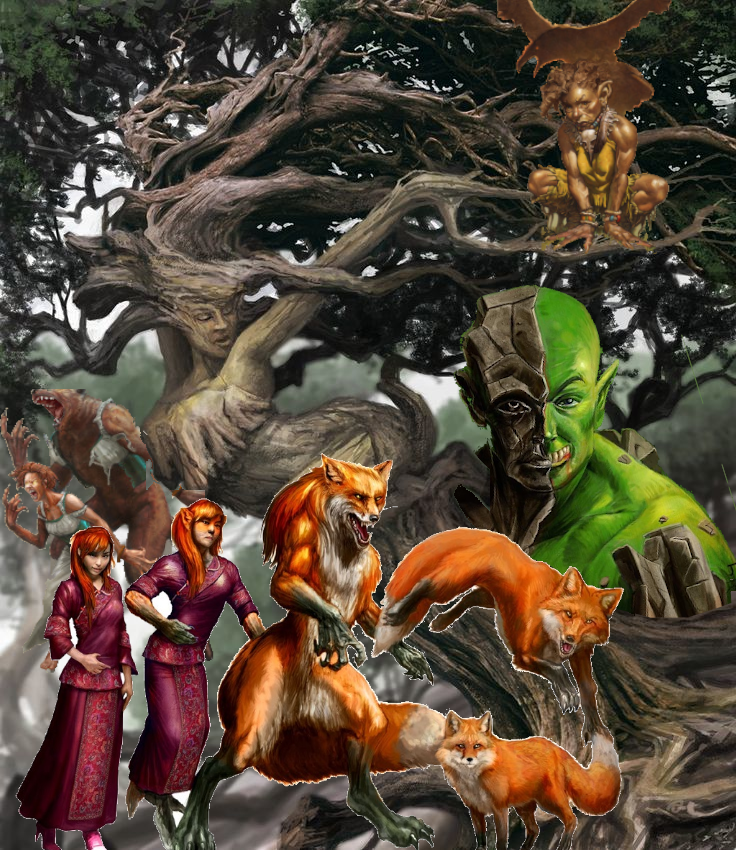
So, for this birthday, either The Mother or I (or maybe we did it together) had an idea to have a “D&D paty,” where his friends could come over (which they haven’t been able to do for the past two birthdays in a row) and we’d all sit around and play D&D all day.  Something self-contained, I thought: a one-shot adventure, designed to be completed in a single session.  And I hit upon the brilliant idea to invent a new ancestry (which D&D often refers to as “race,” which is not only a word charged with real-world baggage, but also just a terrible term for it—“species” would be closer) ... a society where everyone is a shapeshifter.  No need to be a druid, you see: you can just change your shape.  All the time.  To (mostly) whatever you like.

Now, no one’s ever done this in D&D before because it would be difficult to come up with an ancestry that’s (roughly) balanced1  against the core ones: human, halfling, elf, dwarf, etc.  But I had the advantage of being able to say: look, you’re all going to have this ancestry—it’s part of the conceit of the game.  So they were all on equal footing, so balance didn’t really matter.  Plus they could all choose to look like any crazy thing they wanted to.  (If you’re interested to see the stats I came up with, feel free to check them out.2)

And this seemed to work: given the freedom to be able to change shape whenever they liked, they seemed not to need to actually do it in the game—even my shapeshifting-obsessed child never changed into anything the entire session.  So I think I was successful.


Next, I needed a short, self-contained adventure which could be adapted for teenagers.3  I ended up picking a short adventure called Bedlam at the Benefit.  This adventure was short (and inexpensive), and it had a number of advantages:

  • It has a social interaction phase, an exploration phase, and a combat phase, thus giving equal weight to D&D’s “three pillars of play.”
  • How well you do on each phase has an actual impact: the social encounter determines monetary rewards, and “succeeding” on the exploration challenges makes the combat easier.
  • The vast majority of the bad guys are not human—not even remotely humanoid.  There’s no question about whether or not they need to be eliminated.
  • The device of a children’s hospital is going to engage the players immediately: you’ve got to be pretty stony-hearted to not want to help a children’s hospital succeed.
  • It’s very self-contained: you can present this is a mission the characters have been given, they go do the mission, and everything wraps up neatly at the end.

Still, the adventure isn’t perfect.  It had a number of things that I felt needed adjusting:

  • It’s too hard. You’ll notice that this was the one aspect the reviewer I linked to above dinged it for: while it’s ostensibly designed for 5 3rd level characters, it’s likely to wipe out such a party.  Given I was working with younger people, who were not inexperienced, but also not as fully tactical in combat as experienced adults might be, it was probably even more likely.  This one was simple to fix: I just doubled the levels and told everyone to make 6th level characters instead.  Besides, 6th level characters get a lot more cool features to play with than 3rd level characters do, and that’s important for a game where you’re not likely to play those characters again.
  • The monsters are too samey. Basically, other than the mad wizard, you’ve got neogi and gibbering mouthers.  Now, a gibbering mouther is an awesome monster, with a whole bevy of flavorful abilities, and I absolutely adore the neogi, just for the utter insanity of its existence: it’s a spider the size of a large dog with an eel for a head.  But I wanted more variety.  Plus this gave me the opportunity to make sure I could tweak the difficulty of the combat just so: having a bunch of monsters with different toughnesses makes it easier to dial in the exact level of menace you want to portray.
  • Innocent people get killed, by design. This adventure is designed to raise the stakes for you by starting to off the innocent bystanders.  Maybe that’s fine for a group of adult players, but it seemed unnecessarily grim for a group of kids.  This was easy enough to fix as well: I made it so the innocent bystanders would just disappear instead, and then they could all come back at the end (see? everyone’s okay after all).
  • Neogi in D&D are historically slavers. That is, a neogi has a power that it can use to take over someone’s mind and make them do things against their will.  They’re hardly the only D&D monsters that can do this—vampires have a “dominate” power, for instance—but neogi are specifically portrayed as going around enslaving other creatures and using them to boost their own status in their society.  Which is a bit ... icky.  But, above and beyond that, it’s absolutely no fun for your character to get taken over.  In some ways, it’s worse than dying.  And kids hate it even more than adults, I think.  So I took that off the table by reducing the number of neogi to one, and giving it a big creature that it had already dominated (which itself was a pretty horrible monster), so it had no need to try that on any of the characters.
  • Monetary rewards are fairly meaningless for a one-shot. That is, once the adventure is done, handing out a bunch of treasure doesn’t do your character any good, because you’ll (probably) never play that character again.  So essentially you get a bunch of gold you’ll never get to spend.  I handled this by just converting the monetary rewards to bonuses on future rolls, and handed them out right before the big combat at the end so everyone had a chance to use them.

Next, I wanted some cool shapeshifting music.  That just involved scouring YouTube for music inspired by shapeshifting creatures such as werewolves, rakshasas, kitsune, and selkies.  Then I had to arrange the songs into the proper order.4  Then I had a playlist, which you too can enjoy if you’re so inclined.

Next, I wanted some pictures to throw up on the screen to give everyone a the proper atmosphere.  Since this was a children’s hospital that had been converted out of a spooky sanitorium, and they would be arriving close to nightfall, I went with this pic I found on the Internet:

Next, the arrival of the mad warlock and his twisted minions.  For this one, I had to find a bunch of different pics and glue them together with the GIMP.5  My picture editing skills are not great, but I get by.  Here’s what I came up with:

Finally, I needed a map.  I don’t use maps and minis for all my D&D games, but this one was special, and I felt like it really needed that extra oomph.  I employed both the two younger kids to help me put it together—that was a bit spoilery for the birthday boy, but he loves building maps so much that I felt it was better to let him help design the thing than try to keep a surprise.  Here’s what we came up with, as seen in game with minis deployed:

You can see the mad warlock in the center, towards the back of the main entrance; cells with prisoners in them in the back; a few miscellaneous walls for cover; and various statues and other bits of flavor throughout.  Our heroes are towards the front (which is on the left in the picture), either waiting to come in, or already charged in for battle.

Next was trying to get everyone to come up with their characters.  This is a bit like pulling teeth at this age: between indecision and procrastination, it was close to impossible ... in fact, my ten-year-old was the only one who got done early.6  The birthday boy went with an artificer.  There are different flavors of artificer in D&D, but his was sort of a fantasy mad scientist, sporting a “boomstick” (magical version of a musket), a shrink ray, an invisibility suit, and a portal gun (reflavored spells).  My youngest was a college of spirits bard, who communed with ghosts for information and magic.  My eldest was an earth sorcerer/monk, calling upon the stones themselves to help out in combat.  My middle child’s two best friends were, respectively, an owlin (looking) warlock who wielded a giant pen like a spear, and a bard who appeared to look so much like an ordinary human man that it was unnerving.  And that’s pretty much all the prep.

For the session itself, they were given their mission, went undercover as adventurers who were being called upon to impress rich donors and convince them to give more money to the children’s hospital (still under construction, though mostly completed), and actually raised a bit of money for the director (for which I rewarded them with some bonus dice to be used later).  Then, in the midst of the fundraiser, the mad warlock appears on the lawn with his minions and kidnaps a bunch of the rich donors.  They managed to kill both the gibbering mouthers (which made the final fight easier), but the rest of the monsters got away with some captives, as they were designed to do.

Next, they had to explore the creepy basement and sub-basement of the new hospital, which had been sealed up and forgotten about.  It was full of vermin and ghosts, and they had to figure out how to learn as much information about their foe as possible.  This was a skill challenge where each character could pick whatever skill they liked, as long as they could think of a way to describe what they were doing.  So, you could say “persuasion,” and then describe how you talked a ghost into giving you info, or you could say “athletics” and describe how you kicked down a door or moved some rubble to find some clues, or you could say “religion” to recognize some of the mystic symbols scratched into the walls ... whatever you liked.  If you get a certain number of successes before you get half as many failures, you “win” the challenge and the bad guy’s powers are reduced (because his evil, Lovecraftian overlords are disappointed in him, I suppose).  His powers are also reduced if you don’t get all the successes, but you do get at least half of them.  So there’s actually four different versions of the warlock you can face.  Our party didn’t quite cross the finish line before hitting that last failure, but certainly enough to pass the halway mark, so they got a middling version of the warlock to fight.

Then it was time to run the final combat.  This drug out forever, partially because I had probably overestimated how many monsters they could handle, partially because it’s difficult to get kids to focus on the battle and keep things moving sometimes, and partially because I didn’t have the chance to review everyone’s character ahead of time and familiarize myself with exactly what people could and couldn’t do.  But we got through it in the end.  Here’s my battle highlights:
  • The winged pen-wielder did the most damage to the warlock directly, taking out over half his hit points.
  • The artificer killed most of the smaller monsters with a single shot each, and did the majority of the damage to the medium monsters.
  • A well-placed shatter spell from the disturbingly normal-looking bard did exactly enough damage to finish off the medium monsters.
  • The earth sorcerer/monk took on the biggest monster solo and took it down to 2 hit points before it fled and eventually got taken out by the artificer.
  • The ghost bard mainly concentrated on keeping everyone else alive, and ended up healing enough total hit points to constitute a whole ’nother party member.

In the end, almost all the monsters were destroyed outright, the warlock was killed, sending the few remaining monsters back to their other plane of existence, and releasing the trapped prisoners (even the ones who had disappeared).  The director thanked them all, the ancient evil was vanquished permanently, and the hospital was able to open in safety.

So I think everyone had a great time, despite us running close to twice as long as we originally planned, and I think they were satisfied with their characters and their success.  My two youngest (that is, the birthday boy and his little sister) are already talking about bringing their characters back for more stories, so I take that as a positive sign that it was a good time.  It was a bunch of work on my part, and it sucked up a lot of my time over the past few weeks, but I think it was all worthwhile to hear everyone cheer when the bad guys were defeated at last.

Hopefully we get to do it again sometime.


__________

1 Personally, I don’t believe things have to be precisely balanced in D&D.  Just not grossly unbalanced, if you see what I’m saying.

2 As always, credit for layout primarily goes to GM Binder.

3 Technically, my youngest is not a teenager yet, but she was probably the most mature child at the table, so I wasn’t worried about her.

4 See my series on music mixes for why I’m so obsessed with the order songs play in.

5 The GIMP—GNU Image Manipulation Program—is the open-source alternative to PhotoShop.

6 And possibly the only one who was truly and completely done with their character before we actually started playing.


Sunday, April 24, 2022

Birthday Delayed, Now Accomplished

Yesterday was my middle child’s special birthday celebration: a D&D one-shot where he, his siblings, and his two best friends all played shapeshifters on a mission to uncover a hidden evil lurking in a newly-renovated children’s hospital.  While it’s always difficult to wrangle teenagers (plus the one slightly younger and the one slightly older)—and as a result we ran long—it was still a success, and everyone seemed to enjoy it.  Hopefully next week I can post a longer recap.


Sunday, April 17, 2022

Darktime I


"My Shadow Will Cover"

[This is one post in a series about my music mixes.  The series list has links to all posts in the series and also definitions of many of the terms I use.  You may wish to read the introduction for more background.

Like all my series, it is not necessarily contiguous—that is, I don’t guarantee that the next post in the series will be next week.  Just that I will eventually finish it, someday.  Unless I get hit by a bus.]


Welcome to the second of the “transitional mixes”—what I used to call my “mood mixes”—that’s been updated to come into line with the modern mixes.  The first of these was Dreamtime, which has a decent explanation of what I’m talking about with all these terms, but, if you don’t want to go back and reread that, what it basically says is, these mixes were composed almost entirely of instrumental music to set a particular (fairly broad) mood, and mostly consisted of random stuff I found floating around on the Internet.  This one has been reworked a bit more extensively though: part of the reason for that is that, while the original version still felt like it was two volumes, it wasn’t nearly as long as Dreamtime.  So this version has more modern choices, including a couple of vocal tracks, even.

The “mood” of this mix is (as it says on the tin) darkness.  We’re looking for music that just drips darkness, oozes it out of every pore.  Of course, the best types of music for this are darkwave and dark ambient, and we’ve got plenty of it here.  Falling You leans a bit too far into trip-hop for this mix, but Black Tape for a Blue Girl is fond of long, meandering, dark semi-instrumentals, as are German neoclassical-adjacent darkwavers Love Is Colder Than Death.  “A Good Omen” (from the former) is an echoey, bass-heavy affair with wordless vocalizations that are just a step away from moans, backed by mysterious whispers that almost push it into the realm of the creepy.  Meanwhile “Very Ill” (by the latter) is more of a tribal, percussion-heavy foray into a moonless night; there are vocals here, but they seem to come from far away (and are likely not in English, so even harder for us Yanks and Brits to make out).  Unto Ashes is perhaps a slightly less obvious choice, but “Viper Song” is an interesting little tune which seems to evoke a gothic nursery rhyme, backed by what might be a harpsichord (or then again might just be a more common plucked chordophone such as a lute or even a guitar).

On the dark ambient side, Jeff Greinke (who is the linchpin of the Shadowfall Equinox mix) is always an excellent choice, and we have two of his tracks here.  Kevin Keller doesn’t make an appearance,1 but I’ve always felt that Chad Kettering was a musical cousin of Keller’s.2  But “Into the Gate” is a bit more “out there” for Kettering, which is why it ended up here rather on a more traditional one of my mixes.  Seeming to consist almost entirely of echoes, and the small discordancies that you might hear when removing a bow from a cello or when accidentally bumping into a marimba, this is a hard tune to place, in general, but I thought it worked pretty well here.  As for Greinke, I chose “River Limba” off Big Weather, which is a weird little creepy tune, and “Crevice,” off Cities in Fog, which is ... well, also a weird little creepy tune.  The first one sounds more like the frenetic scramblings of small animals (or large insects); the second, like pretty much the entire album from which it derives, sounds more like slowly traveling through a vast, underwater space (or, yes, like wandering through the fog).  Primarily “Crevice” is a bridge to get us to Rapoon,3 whose “Estuary” feels like a continuation of “Crevice,” execept ratcheting up the creepy tension to deliciously unbearable level.  Finally, a short bridge from Michael Stearns and Ron Sunsinger, off Sorcerer, adds a ghostly vibe that flows beautifully from “Estuary” to “Into the Gate.”

There’s also a pretty decent dark neoclassical contingent here: from Amber Asylum’s carnivalesque “Black Waltz” to our closer, Jami Sieber’s “Darkening Ground.” The former we’ve heard from primarily on Shadowfall Equinox,4 and this doesn’t stray too far from that template.  The latter is an uncharacteristically spooky track from the electro-and-acoustic alternative cellist who I first discovered on Magnatune5 and who we’ve heard from many times before on many different mixes.6

And the proper goths should get their shot too: I’ve chosen a short bridge from Clan of Xymox, from their 1986 album Medusa,7 and the meandering, understated, almost muted part 1 of Bauhaus’ 3-part “The Three Shadows,” off of The Sky’s Gone Out.  Neither of these non-vocal tracks were likely to fit anywhere else in my mix universe, but they work really well here.

That primarily leaves the “cinematic” music.  In terms of television soundtracks, I of course couldn’t resist throwing in a Twin Peaks tune—“Night Life in Twin Peaks” is a slow, building tune that doesn’t really build to anything, which only adds to its creepiness—and perhaps the ultimate Darktime pick: the theme from the original Dark Shadows.  I’ve only used this soundtrack once before,8 primarily because it has a very strong 60s-TV vibe that makes it sound out-of-place on many mixes.  But I think this one works well here.  As for videogame soundtracks, I thought Jesper Kyd’s “Meditation of the Assassin,” from the original Assassin’s Creed, slotted perfectly between “Very Ill” and “Crevice”: it’s got that tribal percussion like the former, but also the echoey, lost-in-the-fog feel of the latter.  In the not-really-a-soundtrack category, Dead Man’s Bones, the self-titled debut (and only) album from Ryan Gosling and his equally-ghost-obsessed pal Zach Shields, has been described as the soundtrack to a movie that was never made.  A lot of the album doesn’t work in my opinion, and many tracks that do work don’t fit anywhere traditional.  But, as we’re seeing, Darktime (and its cousins) are home to the oddballs, and I always dug its “Intro,” with the spoken-word poem backed by spooky sound effects.  It’s super-short, but it’s less of a bridge and more the centerpiece of the volume.  Plus it’s one of only two tracks here with any words at all, so I took advantage of that to extract our volume title.

And of course we mustn’t forget my two favorite bands for providing soundtracks to D&D and other tabletop roleplaying games:9 Midnight Syndicate and Nox Arcana.  From the former, “Diversions in the Dark” is practically a soundtrack for Halloween attractions, and, being off the aptly titled Carnival Arcane, flows beautifully into “Black Waltz.” From the latter, “Ghost in the Mirror” is another of NA’s music-box-reminiscent spooky tracks, this one off Legion of Shadows (which is one of my favorite Nox Arcana outings; it’s less tightly-themed, so I think it offers a more varied experience).  And it carries the listener perfectly along from Dead Man’s Bones’ “Intro” to the weird maze that is Love Is Colder Than Death’s “Very Ill.”


Darktime I
[ My Shadow Will Cover ]


“Night Spirits” by Angels of Venice, off Music for Harp, Flute and Cello
“A Good Omen” by Black Tape for a Blue Girl, off The First Pain To Linger
“Persian Teardrop” by Massive Attack [Single]
“Theme II” by Clan of Xymox, off Medusa
“River Limba” by Jeff Greinke, off Big Weather
“Dark Shadows Theme/Collinwood” by Robert Cobert, off Dark Shadows, Volume 1 [Soundtrack]
“Diversions in the Dark” by Midnight Syndicate, off Carnival Arcane
“Black Waltz” by Amber Asylum, off Frozen in Amber
“The Three Shadows, Part I” by Bauhaus, off The Sky's Gone Out
“Night Life in Twin Peaks” by Angelo Badalamenti, off Twin Peaks [Soundtrack]
“Intro” by Dead Man's Bones, off Dead Man's Bones
“Ghost in the Mirror” by Nox Arcana, off Legion of Shadows
“Very Ill” by Love Is Colder Than Death, off Teignmouth
“Meditation of the Assassin” by Jesper Kyd, off Assassin's Creed [Videogame Soundtrack]
“Crevice” by Jeff Greinke, off Cities in Fog
“Estuary” by Rapoon, off Cidar
“Between Parallel Lines” by Michael Stearns and Ron Sunsinger, off Sorcerer
“Into the Gate” by Chad Kettering, off Into the Infinite
“Viper Song” by Unto Ashes, off Moon Oppose Moon
“The Darkening Ground” by Jami Sieber, off Lush Mechanique
Total:  20 tracks,  72:32


On the “possibly unexpected” side of the mix, Angels of Venice are typically new age (which is why we’ve seen them primarily on Numeric Driftwood10), unless you count that one album Angels founder Carol Tatum did with the lead singer of Seraphim Shock.11  But, surprisingly, it’s not that more gothy Carol Tatum collaboration I’m drawing from here: it is in fact “Night Spirits,” the centerpiece of their debut album Music for Harp, Flute and Cello, which is, I’m fairly certain, the only track to include any noises not generated by a harp, flute, or cello.  The opening to “Night Spirits” is all distant, moaning wind, and faint, ghostly voices, and the occasional muted chime.  It settles into a more typical neoclassical AoV vibe after that, but that opening was just too perfect for it not to be the opener here as well.

And, weirdly, I first discovered Angels of Venice by poking around early Internet music-sharing sites.  And that’s also where I found perhaps the most unlikely choice here: a remix/mashup of “Teardrop” by Massive Attack with what I think is Lisa Gerrard’s vocals from “Yulunga (Spirit Dance)” by Dead Can Dance.  We heard the latter on Shadowfall Equinox V; you’ll probably recognize the intro of the former as the theme music for House.  I have zero clue where this incredible mashup originates; I’ve only ever seen it credited as “Persian Teardrop” by Massive Attack, but I suspect that MA had nothing to do with it.  Although of course all the places on the Internet where I originally discovered it are long gone, it seems to have lived on in YouTube form, which is what I’ve linked to above.12  Now, why Elizabeth Fraser (of the Cocteau Twins: that’s whose voice MA employs in “Teardrop”) and Lisa Gerrard (of Dead Can Dance) have never sung together in real life I can’t say for sure (although a 2012 article reports Gerrard saying that Fraser’s approach was too similar to her own), but it does seem like a missed opportunity: both 4AD artists, both pioneers of dreampop, both contributors to This Mortal Coil (albeit never on the same song).  So I completely understand why some enterprising ‘netizen created this.  And I think it’s come out beautifully: Fraser’s atypically intelligible vocals, backed by Gerrard’s vaguely Middle-Easter glossolalia, all set to the techno thump of Massive Attack ... it’s just gorgeous, and I’m glad to have had a chance to showcase it here.


Next time, we’ll hit our first volume eight.


__________

1 This volume.  Next volume ... who knows?

2 We first saw Ketting on Shadowfall Equinox II, appropriately enough.

3 Who we also met on Shadowfall Equinox, though this time on volume IV.  Honestly, just expect artists from SfE showing up here to be a recurring thing.

4 Specifically volumes I and II, but also on Phantasma Chorale II and even on Eldritch Ætherium I.

5 For more details of what Magnatune is and how I discovered it, see the discussion in Rose-Coloured Brainpan.

6 If you want the complete run-down: Shadowfall Equinox IV, Numeric Driftwood II, Rose-Coloured Brainpan II, Smooth as Whispercats I, and Dreamtime I.

7 Their last album before becoming simply “Xymox,” though the “Clan” would return in 1997.

8 That would be Phantasma Chorale II again.

9 For an expansion on what I mean here, see Phantasma Chorale I.

10 Volumes I, II, and III, in fact, although also on Shadowfall Equinox VI.

11 Sometimes you’ll see that album credited to Angels of Venice, though it is usually (and more properly, in my opinion) credited to Carol Tatum.  Certainly that’s how I’ve credited the songs I’ve used from it in my mixes, specifically on Penumbral Phosphorescence I and Fulminant Cadenza I.

12 Although that version has nearly a minute of inexplicable dead air tacked on at the end.  But it’s close enough to get the general drift.