Sunday, July 7, 2019

R.I.P. ThinkGeek


As many of you may know, ThinkGeek disappeared from the web this week ... you can still put the address into your web browser, but you’ll end up on GameStop’s site instead.  For the most part, it went quietly, without huge fanfare.  Some of us former employees “celebrated” this event the way we’d always done when someone left the company: we drowned our sorrows in tacos.  If you’ve seen a hashtag #TacosForTimmy—well, you probably haven’t, as it wasn’t trending worldwide or anything, but you can check it out on Instagram or Facebook.  But saying goodbye to TG was what that was all about.

I’ve mentioned before that I worked there, albeit briefly.  In fact, I once did a blog post talking about my time doing the Ask Timmy column.  Now, on the occasion of ThinkGeek’s (metaphorical) passing, someone suggested that I might be inclined to do one final Ask Timmy as a sort of eulogy.  I considered this quite seriously.  But the problem there is, Timmy is wise and clever and, most of all, he’s always nice.  I’m not sure that my own feelings on what ThinkGeek meant can be that restrained.  Truth be told, I have a little bit of bitterness about the whole thing, so let me get that out of my system first.

First, a bit of history.1  These 3 pals Willie, Jen, and Scott were running a small ISP, back in the days when there were such things as small ISPs, and they had an idea for a side business, selling geek T-shirts and electronic doodads from a separate website.  They enlisted one of their ISP empmloyees, Jon, to pitch in, and the original thinkgeek.com was born.  Shortly thereafter, it got slashdotted and the resulting traffic brought the servers down.  That’s when they knew that they had hit upon not just an idea that people would pay for: they were hungry for it.

It was the very late 90s, and the dot-com bubble had yet to burst ... although, even when it did, ThinkGeek survived.  Nowadays companies such as Nerdist and Geek & Sundry get a lot of (very deserved) credit for the proliferation of nerd culture ... but, don’t forget that ThinkGeek predated both by over a decade.  In fact, while we can always quibble over the details, I would contend that ThinkGeek was the original purveyor of “geek chic,” and that it was a really big part of why geek is now big business.  Which can only lead to the question: what happened?

So, here’s my theory, and you can take this with as much salt as you care to: I was sort of vaguely an insider, but only for a very brief period (about 3½ years out of ThinkGeek’s 20 year history).  So I’m speaking about 82.5% as an outsider, really.  Bear that in mind.

As part of one of my other series I’m working on, I’ve actually done a bit of historical research on TSR, the company that originally created D&D.  It’s a complex story, but I think I can sum it up pretty succinctly: it was started by a geek (Gary Gygax), then it started making money, then the business people came in and forced him out, then they nearly went bankrupt.  It was eventually bought, by the way, by Wizards of the Coast, which was started by a geek (Peter Adkison), then it started making money, then the business people came in and forced him out, and then they got bought by Hasbro.2  This is nothing new, of course: Netscape was also founded by a geek (Marc Andreesen), then it started to make money, then the business people (in this case AOL) came in and forced him out, and now it’s a dead browser.  Remember Slashdot, the catalyst of ThinkGeek’s early success?  Founded by a geek (Rob Malda), started making money, then the business people came in (the same corporate entities that would go on to buy ThinkGeek, coincidentally3) and forced him out and now I can’t name anyone who still goes to the site for their news.  Hell, this pattern goes all the way back to Nikola Tesla, if not further.4  And it’s still going on today: Chris Hardwick and Felicia Day seem to be gone from Nerdist and Geek & Sundry after their purchase by Legendary (and then repurchase by a Chinese conglomerate).  And, again, we can quibble over details—for instance, I’m sure some of those geeks would disagree with my characterization of them being “forced out.”  A number of them left pretty unwillingly, but several of them decided to move on all on their own ... and yet I find it hard to believe that any of them wouldn’t list “increasing corporatization” as a contributing factor to their exits.

And, amidst all of what seems to me to be a pattern so clear even a monkey could pick it out, there seems to be this meme that geeks are just terrible businesspeople.5  For instance, I just dug out an old podcast featuring two scholars who wrote books on Gygax, and they both agreed on his lack of business acumen.  And yet ... what was step two of that recipe?  Step 1 was the part where the geek starts a business because they have a product that they’re passionate about and they want to share it with the world.  Step 2 was the part where it started making money.  Because, let’s be crystal clear on this: the big corporations don’t want anything to do with you if you’re not making lots of money.  Oh, sure: they always think they can make more money than you could on your own ... and yet they always seem to be wrong, in the end.  Probably just coincidence.

Now, part of the reason the “good” businesspeople never take any of the blame for the eventual (entirely predictable) failure is that such failures inevitably take a long time.  And, in the meantime, there are still wonderful, creative people working really hard to produce good things despite the terrible ideas the people who are ostensibly good at business are forcing on them.  TSR, for instance, produced some of their most iconic products and settings after Gygax left.  And ThinkGeek was certainly no exception to this rule.  Some utterly fantastic products were produced well after ThinkGeek was bought, and some utterly fantastic people worked there, some of whom I’ve had the pleasure of meeting despite never having had the chance to call them my coworkers.  I would never want to diminish any of the contributions of these folks.  But I have to say the downward spiral always seemed inevitable to me, and it was one of the reasons I left when I did.

ThinkGeek was bought by Andover.net, and Andover was bought by VA Linux, which changed its name to VA Software, which changed its name to SourceForge, which changed its name to Geeknet, which was almost bought by Hot Topic, but then was bought instead by GameStop.  And now it is gone.  And geeks everywhere are sad.  Honestly, I feel like it’s not so much that geeks are bad businesspeople as it is that businesspeople are bad geeks.  See, geeks know what geeks want to buy—I can’t believe that I have to say this like it’s some sort of profound statement when in actuality it’s sort of self-obvious.  Businesspeople, apparently, do not know what geeks want to buy, or how to treat them well.  They always seem to have these grand plans, and of course they know better than everyone else how to make money ... except they kinda don’t.  Any entry-level course on business will tell you that one of the most important concepts in order to be successful is to understand your market segment.  And yet, corporate overlords, again and again, think they know better and push out the people who know what they’re doing—the people who made the companies successful in the first place.  Then they just sort of flounder around dopily until they realize they have no clue what they’re doing and they either shut it all down or sell it to some other corporate sucker and congratulate themselves on a job well done.

Jon left first, and then Scott, and then Jen, and finally Willie, in 2013.  I wasn’t there for the last 3, so I can’t say for sure, but I deeply suspect that at least some of them didn’t go willingly.  I was there when Jon left, and so I can tell you for a fact that he was pushed out, in the sense that the corporate people running the place made it so miserable for him that he finally just gave up.  I know this because I was asked to participate in it.  I refused, and so I was next on the list of “how toxic do we have to make the environment before he leaves?”  The answer was, not too much more so.  I left ThinkGeek in 2007, after a really dumb argument with the manager who was the extension of our corporate rulers,6 and I moved here to California.  Where I am really really happy, and my family is very happy, and I have a pool with a jacuzzi and all that, so it’s not like I’m complaining.

Except ...

Except that, despite the fact that it comprises only around 10% of my career as a software guy, my short tenure at ThinkGeek was one of the best experiences of my life.  I had just come off 13 years of running my own business, which I only did because I was convinced that it was literally the only way to have a company that was a fun, respectful place to work.  I probably would have kept on doing that forever, except that the dot-com crash indirectly borked me by flooding the market with all those “programmers” who had gotten into the business during the bubble and now were willing to work for cheap.  They couldn’t match our quality, of course, but, at the point at which a company can afford to hire 3 or 4 such schmucks for what they used to pay us, they just figured they could make up the quality with quantity.  And I was forced to go work for someone else again, and I figured I would hate it.

Instead, I met Jon and Andy (who, despite being inherited from Andover was not a corporate shill, but rather one of the best bosses I’ve ever had) in a restaurant / pub, where we had some dinner and drank some beer and talked about whether I’d be a good fit for ThinkGeek.  All the cultural stuff they talked about sounded awesome—too good to be true, if I’m honest—and it was just left for me to have a more technical 1-on-1 interview with Jon.  Should I come by early in the morning some time?  I asked this with some trepidation, as I kind of suck at mornings, but I knew that was what was expected in the corporate world.  There were chuckles.  A lot of the ThinkGeek crew aren’t morning people, I was told, and Jon certainly isn’t.  Come by in the evening after the work day is mostly done.  I breathed yet another sigh of relief.  When I pulled up to the front door (it was, in those days, a small office on the backside of an office park about the size of a strip mall), Jon happened to be outside smoking.  I put on my emergency flip-flops, got out of the car and smoked with him, mostly in silence.  Then he said, let’s go in and talk, and we walked through the door, and the first thing he did was take his shoes off, and I was pretty much in love.  In love with the company, in love with the philosophy, in love with the dogs at the office and the cool toys that were always lying around and the loud music that we played for “inspiration” and the company videogame consoles and what passed for “meetings” which was mostly us sitting around a table and acting goofy while coming up with cool ideas, but mostly in love with the people.  I’ve written plenty about my love for Willie, so I won’t repeat it here, but I loved all those guys.  Jen, who was the first person I ever met who called themselves a “web designer” that wasn’t a pretentious bastard but rather a smart, thoughtful person who had style and understood how the web really worked.  Scott, who was one of the most down-to-earth guys I’ve ever had the pleasure to work with and was just a joy to be around.  JenVon, who was one of those no-nonsense types who always knew exactly what was going on and how to do things more efficiently, and yet still was super-fun to hang out with.  And of course my fellow code monkeys: Jon, who knew how to put his head down and just get shit done, who was often quiet but had a sly wit, and absolutely magnificent taste in music;7 and his eventual replacement Jacob, who was so earnest and genuine and probably cared more about the people who ultimately benefitted from the website (a.k.a. our customers) than anyone else I’ve had the pleasure to work with.  And all the rest of my ThinkGeek peeps like Andrea and JennK and even the people who I never met until much later like Kate, and many more: I love you all, guys.  You changed my life for the better.

Which, you know, sounds ... well, to call it “hyperbolic” probably seems like an understatement.  It probably sounds like overblown bullshit to many of you.  But it really is difficult to convey how impactful this one job was for me, and (I’m pretty sure) for just about everyone who worked there.  Oh, sure: we all bitched about corporate this or that, and we fought sometimes (as all work siblings do), and we had some bad days.  But we all respected each other, and we not only tried to have fun, we mostly succeeded.  More than that: we believed it was part of our job to have fun.  Not just work hard all day and play hard all night, but actually play while we worked, so that just about every day you would wake up and go, yay! I get to go to work today!  Most jobs aren’t like that ... most jobs don’t even come close.  But I got to do that for 3½ years, and I will always be grateful to the people that made that happen, and just a touch bitter about the people who made it go away.

So perhaps one day I’ll readopt the calm, soothing, wise voice of Timmy the Monkey and do a more proper eulogy: you know, the kind where you only say nice things about the deceased and ignore any faults they might have had.  But this week I’m feeling too raw for that.  This week I’m feeling a lot of mixed emotions, and I wanted to let them all out, both good and bad.  Because ThinkGeek was a beautiful, shining thing, and an important cultural thing, and I feel like it was taken from us too soon, by people who were greedy and yet probably didn’t end up getting rich, people who thought they knew what we wanted more than we did, people who probably looked down on us a little bit but had no problem profiting off our talents.  Those were not good people.  But still they cannot sully the memory I have of what ThinkGeek meant to me, and I’m sure what it meant to all its former employees.  We got to do something we loved, every day, and we kicked ass at it, and they even gave us some money for it.  And you can’t say fairer than that.


__________

1 Remember, I wasn’t actually there for ThinkGeek’s birth, so you’re getting all this second-hand.  My memory is no doubt faulty in places, and the memories of those that told me the original stories may have been faulty in places, and anyway “what really happened” is a bit of an aspirational myth for all stories, if you think about it.

2 Many would say that Wizards also has gone downhill ever since, but it must be admitted that they’ve had a bit of a resurgence of late.  Hopefully they can end up being the exception to this pattern.

3 Or maybe it wasn’t coincidental at all; that’s a part of the story I was never privvy to.

4 By the way: July 10 is Nikola Tesla Day.  Be sure to celebrate.

5 To be clear, this pattern isn’t limited to just geeks: creative types of all sorts have experienced this exact pattern, and they’ve also been accused of being bad at business.  It just so happens that geeks are the ones I’m most familiar with.

6 I’ve actually told this story before, in my post on fate.  However, at that time, I was being a bit more coy about what company I was talking about.  At this point, I don’t really see much point in such subterfuge.

7 Okay, except for the K-pop.  Sorry, Jon: I still can’t get behind you on that one.


Sunday, June 30, 2019

Have a lovely Independence Day


Nothing exciting this week.  Just getting ready for a short work week then maybe go see some fireworks on Thursday.  Longer post coming next weekend.


Sunday, June 23, 2019

D&D and Me: Part 2 (Mapping Out the Territory)

[This is the second post in a new series.  You may want to begin at the beginning.  Like all my series, it is not necessarily contiguous—that is, I don’t guarantee that the next post in the series will be next week.  Just that I will eventually finish it, someday.  Unless I get hit by a bus.]

[When we left off last week, my love of lists and my love of horror had collided, and I had decided to come up with the ultimate list of monsters.]


I started learning about monsters from reading about mythology, of course.  There are lots of cool monsters and magical beasts in Greek and Norse mythology: Pegasus and Medusa and Fenrir and Ratatoskr and dryads and naiads and fire giants and dark elves and birds with bronze beaks and horses with eight legs and that’s only scratching the surface.  But this was not sufficient.  For some reason I had decided that I was going to write novels about this fantasy world where every possible monster or magical creature was a separate, sentient race.1  Looking back on it now, we’re talking about the years between roughly seven and eleven, and it seems almost ridiculous when I tell you that I was attempting to write novels, or that I was imagining sophisticated concepts like the various races fighting over what counted as “sentient” and therefore determined whether this or that creature would be a recognized race, but I suppose I was a precocious child.2  And of course the line between “fantasy race” and “monster” is very fine indeed, so the vampires and rakshasas and kelpies and harpies and peri were welcomed into my fantasy milieu.  And I knew perfectly well that books on monsters were the best place to find new fantastic creatures.

Now, I’ve already written at least a little bit about my preoccupation with Monsters Who’s Who, but I don’t think I fully captured why it was special to me.  Remember that last time I talked about the great respect that my family always had for books.  I should also mention that my father was3 a bit of a cheapskate, so, when I would beg for toys, or comic books, or anything along those lines, I usually got a “no.” But begging for books was a much easier row to hoe.  You can deny a kid a Star Wars action figure on the grounds that it’s frivolous, but denying them a book?  Unthinkable.  At least I’m pretty sure this was my father’s position.  So we were window shopping at the mall (we did that a lot when I was younger), in a Border’s or somesuch, and I found this book, which was really more of a “coffee table” sort of volume—great pictures, light on the actual information—and it had all these cool monsters in it, and they were super liberal on what they counted as a “monster”—not only comic book villains like Annihilus and Ultron,4 but even superheroes5 and 50s monster movie antagonists like the Blob and Quartermass (which is possibly a worse sin than referring to Shelley’s monster as “Frankenstein”)—but I wanted it.  So I begged, and I got it.  And I read it over and over, and it was cool, but ... there should be more.

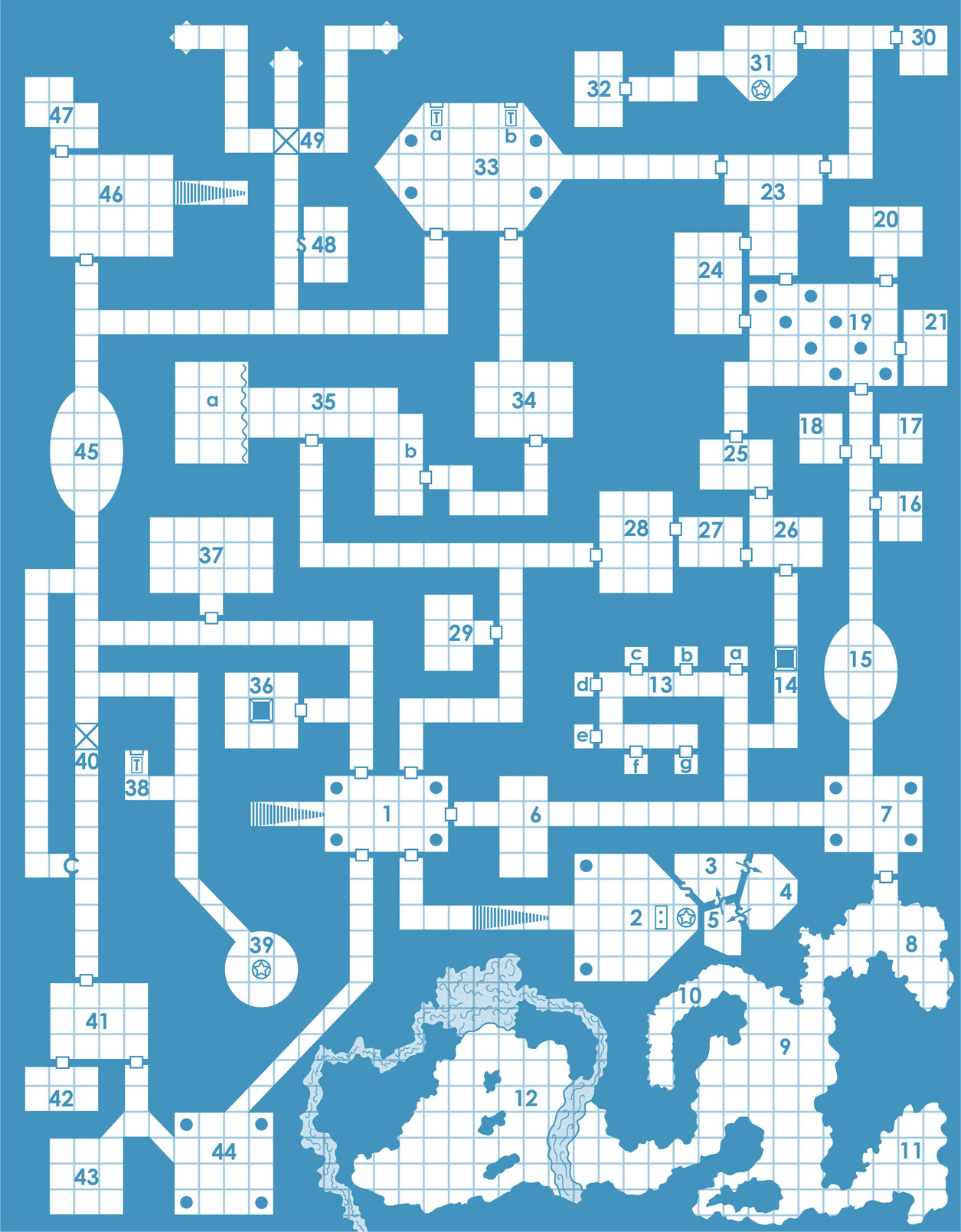
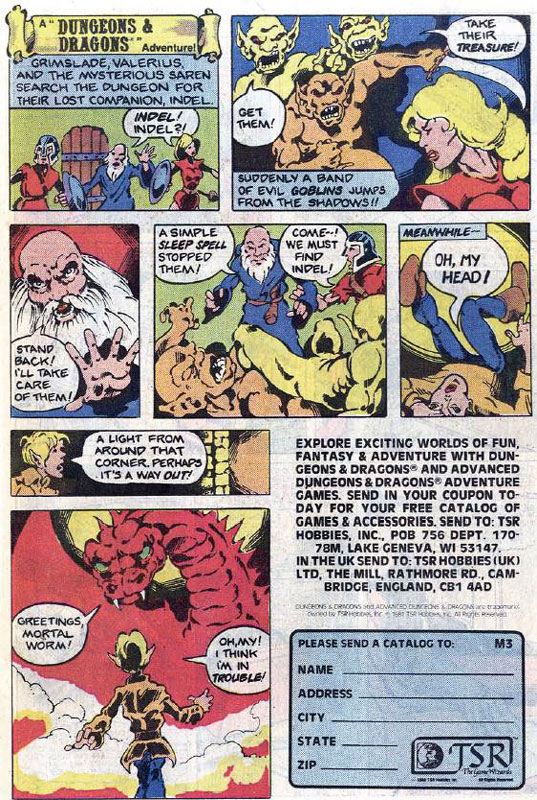
I honestly cannot remember where I first heard of Dungeons & Dragons.  In addition to having a thing for monsters, I also had a thing for games, even though I never really had anyone to play with me (I was an only child until age eleven).  So here was a game, and it was also full of monsters!  You know what? I bet I saw an ad for it in a comic book somewhere.  Doesn’t really matter.  Point being, I had to have this creation.  I needed it badly.  And, eventually, I got it ... maybe for Christmas one year?  I can’t recall.  I remember it being the so-called “blue box,” and I remember it having cool (and bizarre) monsters, as expected, but probably the thing I remember best is the dungeon: it was laid out on a grid, beautiful straight-edged halls and rooms, with a little bit of more irregularly-shaped cavern in one corner.6  But screw those curvy walls: I was all about the straight lines.  There’s just something about all those perfect, 10-foot-wide dungeon corridors, with their 20x20 or 40x40 rooms to one side or another, that really strummed my OCD, and for a long time I became obsessed with drawing dungeons.7  I asked for graph paper, which my mother thought odd, so she got me some of that stuff with the little green squares.  No, that wasn’t right, I said: these squares are too small.  Ah, my mother says: you want quadrille paper.8  Blue squares, and bigger (according to Wikipedia, graph paper is 5 squares per inch, while quadrille paper is 4 squares per inch).  And my father worked at a paper mill, so he could get all sorts of paper for cheap or maybe even free; I don’t recall.  But I do remember going through several pads of quad paper making dungeon after dungeon.

Now, understand: in all this time, I never actually played the game.  In the first place, I had no one to play with.  Still not many friends, and my little brother would have just been born, assuming I got the game shortly after it was first published.  But, probably more importantly, the rules of these early versions of D&D were kind of insane, and often contradictory.  For instance, I’m pretty sure that there were at least some cases where it just wasn’t possible to resolve whether someone was surprised or not, because your opponent could succeed on a roll to surprise you and you could simultaneously succeed on a roll to not be surprised.  (Perhaps from this you can guess that I was obsessively reading and rereading the rules, despite having no real opportunity to apply them anywhere.)  So no real playing, just reading, and “collecting” all the monsters, and drawing dungeons just to draw them.  I bought the original Monster Manual (because: more monsters), but I never picked up any of the other books, because I had no need for them.  Until ...

So I mentioned earlier that my little brother (and only sibling) would have just barely been in existence at the time D&D came out: in fact, they share a birth year (1977).  There are 11 years between the two of us, and while there are certainly advantages in being the only child (and only grandchild for much of that time), I had decided that I really wanted a sibling.  So I was thrilled when my brother was born.  Finally! someone to play games with!  But, you know, babies don’t exit the womb able to play games.  The situation hadn’t improved much when I was 12 and he was 1, and 13 and 2 made little difference as well.  At 14 and 3, we could at least graduate from peekaboo to tic-tac-toe, and by 15 and 4 simple things like Candyland or Uncle Wiggily were feasible, but, still ... I was getting impatient.  This whole sibling thing took way more patience than I was (and still am, for that matter) prone to.  By 16 and 5 we could really start to get into some good games, but of course by that point I was in high school, and I actually had some friends (although not the sort that might be interested in D&D, as near as I could tell), and I had less and less time to play games with my little brother.  When was it that we first hit on the idea of me running a D&D game for him?  17 and 6? 18 and 7?  Probably closer to 19 and 8, but somewhere during those years.  By this point I had read the rules of D&D so often that I knew them very well, but I had still never played, so starting out as the putative DM (that’s “dungeon master” for the uninitiated) was just insane.  I had zero clues about what I was doing.  Also, running a game where you have only one player is tough, because D&D is really designed to be a game where players work together to solve challenges, and character classes (especially back in those days) had pretty narrow lanes for what they were good at.  I don’t remember much about this game, but I think my brother wanted to be a sort of classic knight, so obviously a fighter with heavy armor, and we went through one of the many dungeons I’d drawn, with random rooms full of random monsters and absolutely no rhyme or reason why any of them were there, just sitting in a room (with no food or anything else to do) waiting for someone to bust down the door.  A fighter, of course, is quite excellent at busting down doors, and pretty darned good at killing whatever’s on the other side, but has no magic at all, can’t heal himself, and (perhaps most importantly for a classic dungeon crawl) has no ability to identify and disarm traps.  So I dreamed up an NPC9 who would be a pixie rogue, thus providing a bit of magic and the requisite trapfinding—I can’t rememember what the hell we used for healing—and I made him a statue in the early part of the dungeon with a puzzle that my brother’s erstwhile knight could figure out to free the pixie from his stony prison.  Once freed, the pixie was so grateful that he agreed to accompany the knight deeper into the dungeon.  My brother, into animals nearly as much as I was,10 also brought in a fierce fighting dog to help out with the combats.

I can’t remember how long we played this ... well, I hesitate to glorify it with the title of “campaign,” and really it was only an “adventure” in the broadest sense, but these few sessions of D&D that were his introduction and, in a weird way, mine too.  More than once, certainly, but as many as five times?  I can’t recall, but it couldn’t have gone on too long.  I had other things to do, and typically when you play D&D you play it for quite a few hours at a time, so it was a pretty big time commitment.  Was it perhaps 10 hours of gaming, spread out over several sessions across perhaps weeks? could it have been 20?  Surely no more than that.  But it was influential in a number of ways.  Firstly it gave me a taste for the game as roleplaying, above and beyond the cool factor of the monsters and the gridded dungeons.  Secondly it instilled a lifelong love for the game in my brother, who continues to play even more than I do and most of whose online identities are named after his favorite D&D character.

But it also gave me what may be an atypical experience of the game.  There were no rules for “fighting dogs” or pixie rogues ... hell, there weren’t any rules for lots of things back then, but certainly not for esoteric things like that.  I had to make that shit up.  So my very first experience playing D&D was me homebrewing a bunch of shit and then running a dungeon crawl.  Maybe I’m wrong and that’s not that unusual, but I kinda feel like it was a weird way into the hobby.  Certainly it’s given me a base of understanding that, more so than any other game, the rules of D&D are ... malleable.  You can always add in your own touches to Parcheesi, or Monopoly—how many of us were adults before we realized that getting money for landing on Free Parking wasn’t actually a rule?—but customizing D&D is a whole ‘nother level of creativity.  I want to explore this more in a future installment, but for now, chronology demands that we back off from my career as a DM and see me finally become a player.


Next week: off to college.  Again.

__________

1 The age-old debate over whether e.g. “a pegasus” isn’t really a thing because “Pegasus” was the name of one unique individual was never an issue for me.  From my budding authorial perspective, any dilemma of this type was instantly solved by whichever answer increased the number of races in my fantasy world.

2 This is possibly a bit of an understatement.  But I have to tell you, from both my experience as a child and as a father: children suck at having the good sense to realize that they’re “too young” to accomplish something.  Or as Pearl S. Buck once (much more eloquently) said: “The young do not know enough to be prudent, and so they attempt the impossible—and achieve it, generation after generation.”

3 Okay: is.

4 Who I was mostly unfamiliar with because, as I mentioned last week, I wasn’t reading Avengers or Fantastic Four.

5 Really? Spider-Man as a “monster”?

6 One would think that, what with everything being on the Internet these days, I could find an image of that exact dungeon.  But, alas, I couldn’t, though I found several that were close.  The one that felt closest to what I remember is Blue Dungeon 013 by Tim Hartin.  Creative Commons share-alike license.

7 In retrospect, my lack of artistic ability may have fed into this.  I couldn’t draw a dragon to save my life, but, given graph paper, a pencil, and a ruler, I could draw the shit out of some dungeons.

8 I have to admit that, until I started writing this very series, I never knew how that was spelled; I always thought it was “quadrle” or somesuch.

9 I suppose this was technically my very first GMPC.

10 My favorite kid-quote from my brother: he once announced, quite seriously, at age 8 or so, that he was opposed to nuclear war, because it would kill all the pets.  Wasn’t worried about the people, you understand: just the pets.


Sunday, June 16, 2019

Another Father's Day rolls around


You know, when I wrote last week that a longer post this week should be “achievable,” I totally forgot that it was Father’s Day.  Today my lovely children (and The Mother, of course) are taking me to see Avengers: Endgame, which is, what? 6 hours long?  So I think my day is pretty full already, and I’m only setting myself up for failure (as The Mother would say) if I try to work in a long blog post too.  So let’s skate one last time and I’ll just wish everyone a happy and brilliant Father’s Day, even if they’re not fathers—doesn’t mean you can’t celebrate the general concept of fatherhood, which I can tell you from personal experience is pretty great.  Love to all my minions from their Gru.

Until next week.


Sunday, June 9, 2019

This damned knee ...


I really tried to get a proper post for you this week, as the regular schedule would indicate, but some medical issues caused me to fall behind on my work a bit, so I need to concentrate on that, unfortunately.  Next week should be achievable.


Sunday, June 2, 2019

Some fun Game of Thrones videos


As you noticed, I didn’t post the final installment in my Game of Thrones reaction posts last week.  It’s coming, I promise, but I still need more time to polish it.

In the meantime, I’ll give you something else to do.  I’ve been watching a lot of Game of Thrones related videos online lately, and many of them have expressed my thoughts on the final season rather succinctly.  If you haven’t yet watched these, you may want to check them out.

I shouldn’t have to mention this, but ... MAJOR SPOILERS FOR SEASON 8 IN THE BELOW VIDEOS.


First, the inimitable Scooter Magruder.  Apparently he does a lot of sports-related videos, which probably explains why I’d never heard of him before.  But he also does a few other things, such as videogame reaction videos, and, of course, Game of Thrones reaction videos.  Here’s the complete set of his videos for this latest season.


I don’t think I have ever watched a video where everything the person said was exactly what I was thinking on the topic too, but I can’t find a single point of disagreement with Mr. Magruder on the topic of Game of Thrones season 8.  It’s like the guy lives inside my head or something.  Episodes 3, 5, and 8 are probably the best, but they’re all great.  Highly recommended.


Next, this fellow Ryan George does “pitch meetings” for different shows and movies where he plays both sides: that is, he’s both the person with the crazy (generally stupid) idea and also the executive who has doubts but is willing to play along.  You know what? it’s easier to just watch them than listen to me try to explain the concept:


I don’t agree with Mr. George on everything, but his take on season 8 is pretty damned spot-on, and also hilarious.


Finally, just for fun ... this is nothing to do with season 8, but just something I stumbled across and had to share: “Ice Ice Baby” by the Game of Thrones characters.  You’re welcome.


Next week, something more substantial, although I have no idea what.


Sunday, May 26, 2019

D&D and Me: Part 1 (The Time Beforetimes)

[This is the first post in a new series.  Like all my series, it is not necessarily contiguous—that is, I don’t guarantee that the next post in the series will be next week.  Just that I will eventually finish it, someday.  Unless I get hit by a bus.]

[This series is about my discovery of and (occasionally stormy) love affair with D&D.  You may wish to think of it as an alternative to 23andMe, since D&D is embedded far deeper in my DNA than any silly “chromosomes.” Or think of it as a complement to my series on the Other Blog “Perl and Me.” This will probably be a bit shorter than most of my series.  Probably.]


I’ve had an on-again-off-again relationship with Dungeons & Dragonsor “D&D” for those in the know—for most of my life.  For a long time, I took a detour into Heroscape, and I still love (and play) that game too.  But I’m entering a more “on-again” phase, mainly in that I’ve (finally!) discovered the joy of watching people play online.1  As I’m always interested to find out more about the people behind the art I enjoy—whether that’s musicians, authors, filmmakers, or what-have-you—I’ve also spent a little bit of time listening to some of these people I’m watching talk about how they got into D&D.  And that made me want to tell someone how I got into D&D.  So here I am, telling you.

Because I never met a tangent I didn’t like, I have to start with the pre-D&D stuff.  There were lots of interests that came before I even heard about D&D, and lots of intersecting interests and interests that grew out of it.  Any story about a thing is always about more than just that thing.  For me, as a very young child, the two most important pieces were no doubt fantasy and horror.  And for that we need to talk about books.

I was an only child for the first 11 years of my life, and, while I loved games, I rarely had anyone to play with.  I didn’t make friends very easily, and I was a very short kid, and quite sensitive about it.  So I spent a lot of time by myself, and most of that time I spent reading books.  In my house, movies were awesome, and we went to see quite a few, and television was awesome, and we watched quite a lot of it, and music was intensely important—I may have mentioned before that my father was a record collector—and we listened to a shit-ton of that, but books were king.  No one ever discouraged me from reading comic books, or watching cartoons, or any of that stuff (my dad, in fact, had been fond of comics himself as a kid, so I think he was secretly a bit happy when I started to get into comics), but it was just always clear that books were the ultimate medium.  Everything else was second tier ... at best.  We had entire walls of our house devoted to books, as well as books in cabinets, books in boxes, bookcases stashed into odd corners ... books everywhere.  I had a bookcase in my room as well, of course, and the very first book I can remember reading, after all the Dr. Suess and P. D. Eastman and Berenstain Bears, was a book on Norse mythology.  It was a book aimed at younger readers, so it was a bit watered down, but I learned a lot about Odin and Thor and Loki before I ever saw them in the pages of a Marvel comic.  From there I gave up on the kids’ versions and starting reading Bulfinch’s and Larousse.  It was a short hop from there to The Hobbit and The Lion, the Witch, and the Wardrobe.

Probably around the same time, I started getting into comics.  However, I always had a very weird approach to buying comic books: if the cover featured anyone even remotely recognizable—your Supermans, your Batmans, your Spider-Mans, your Fours of the Fantastic variety—I didn’t care much about them.  I wanted comics with pictures of heroes I had never seen before, never even heard of before.  The first comic I can ever remember buying was Atlas #1: that Jack Kirby artwork is always an eye-catcher, I was of course familiar with the name from my studies in mythology, and I had inherited enough of the collector gene to know that a #1 issue could become a valuable commodity ... even at 8 years old, which is how old I must’ve been, according to Wikipdedia’s publication date.  From then on, I would buy anything that had a superhero or two—or, even better, a whole bunch!—that I had absolutely no idea who they were.  It’s why I bought the “origin” issue of Black Orchid, and Ragman #1, and Moon Knight #1, and absolutely why I got into the Legion of Super-Heroes and the original Guardians of the Galaxy.  Teams of misfits with weird powers appealed to me, and really the only truly popular characters I ever liked were the X-Men, and that was only because they rebooted the group with a a whole new batch of crazy unknown heroes—mostly non-American, even!2  Not my fault they got all popular after that.

It’s worth asking why I was only interested in the weird, unknown heroes, and I’m not entirely sure I have a good answer.  But I have a theory.  See, as a kid, I was a little OCD—had I been born 25 years or so later, I might have been diagnosed as being on the spectrum, at least a little.  ADHD at the very least.  But, anyway, one of the ways in which my particular brand of OCD manifested was in my obsession with lists.  My mother would indulge me in this (or maybe she was indulging her own predilection for having children able to recite things back to her, who knows) by teaching me various lists of things.  First she taught me how to count to 10 in Spanish.  Then in French.  Then in German.  Then in Malaysian.3  Then she taught me the Greek alphabet.  Then the books of the Bible.  Then all the US Presidents.  Then she sort of ran out of things to teach me and I started chasing lists on my own.

I always loved animals, so I started reading this set of wildlife encyclopedias we had lying around.  But trying to come up with a list of all the animals in the world isn’t like coming up with a list of all the presidents: we don’t even know all the species of animals at any given time—a fact which was already blowing my young mind—not to mention the fact that the list is constantly changing as new species spring into existence or go extinct.4  And when it comes to classification, the classic Linnaean taxonomy (phylum, class, order, family, genus, species) held strong appeal for my orderly brain, but it turns out that people were always fighting over what went where.5  The main controversy I recall was that rabbits were put into the “new” order of lagomorpha, although the books made it clear that some taxonomists might still be hanging on to the “outdated” idea that they were rodents.  This pretty much blew my mind, since of course my mother had taught me that rabbits were rodents, and common sense told me they were rodents: I mean, come on, they’re small furry creatures with big buck teeth—of course they’re rodents!  But apparently scientists not only knew otherwise ... they had once believed it and then changed their minds.  Insanity.

I fared no better trying to learn the countries of the world.  Surely this was an area where one could come up with a clear list.  And yet ... was Estonia a country?  They had an embassy in the US, but the UN didn’t recognize them.  What about the Bantustans of South Africa?  The opinion of my brand-spanking-new World Book Encyclopedias was that two of them (Lesotho and Swaziland6) were countries, but the remainder (such as Bophuthatswana and Transkei) weren’t.  Plus South Africa had two capital cities: how was that supposed to fit into my nice listing of countries and their capitals?  And it continued to get worse: every year they would send us “year books” with updated and entirely new articles, and they actually came with little sheets of stickers you were supposed to stick in the margins of the main encyclopedias, alerting you to an updated section for this article or a whole new article between these other two articles.  I very diligently applied all these stickers for many years, and I distincly remember when the update for 1979 came in and there was a whole new article for St. Vincent and the Grenadines, which was apparently an entirely new country ... one year, no country; next year: country.  Mind.  Blown.

Somehow I didn’t melt down and throw a tantrum when I discovered this.  I just began to chase the lists even harder.  I think I somehow (probably subconsciously) believed I could eventually find all the members and learn all the classification controversies and make my own decisions and then Ialone in the world!—would be the knower of the complete list of X.  Where “X” might be animals, or countries, or perhaps superheroes.  Thus my theory that the lists were responsible for my comic-book-purchasing habits.  No point in buying a “regular” issue of Spider-Man—I already knew who that guy was—but an issue with these new guys Cloak and Dagger ... now there was something adding to my quest to know the complete list of superheroes.

Surely even you, dear reader—used to my tangents are you no doubt by now are—are wondering how on earth this relates to D&D.  For that, we need to look at the other half of my interest: horror.

My parents loved horror.  They enjoyed fantasy, and sci-fi probably even more so, but horror was their true calling.  I started reading Stephen King and Peter Straub and Dean R. Koontz7 at a very young age, and we would go see horror movies like crazy.  I saw The Exorcist in the theater, at a time when I must have just barely turned 7, and The Legend of Hell House, and Jaws, and Burnt Offerings, and Prophecy, and Grizzly, and Day of the Animals, and It’s Alive (in roughly decreasing order of quality) ... all in the theater.  At home on the small screen, we watched even more: I remember Twilight Zone reruns, and I remember Night Gallery, and most of all I remember Kolchak: The Night Stalker, in which a Chicago reporter for a tiny newspaper managed to encounter a different supernatural threat every single week.  His editor (who was properly grumpy and talked primarily out of the side of his mouth, as all good Chicago news editors should) would yell at him about his “cockamamie stories”8 and how “ya got no proof!” The problem with a monster-of-the-week show that you’re supposed to be taking seriously, though, is that unless your protagonist is actually some sort of professional monster hunter (see also: Buffy), or perhaps even is one of the monsters themselves (see also: Dark Shadows9), it starts to strain credulity after a while.  Of course, as a kid, that was not an issue for me.  The bigger problem was that you eventually start to run out of monsters ... or at least out of monsters anyone’s ever heard of.  Partially they solved this problem by occasionally making up monsters—my favorite was the updated take on the Headless Horseman, who was now a headless motorcycle rider with a big sword, zooming around decapitating people—but also they went scouring the cultures of the world for more obscure monsters.  Manitou, rakshasa, succubus ... all these I first became familiar with as a result of avidly watching The Night Stalker.  It was only on for one season, but it was a pivotal moment in my personal history.

Because now, you see, I had a new list to make: a list of all possible monsters.


Next week, we’ll see how that pretty inexorably leads to my discovery of Dungeons and Dragons.

__________

1 Most likely we’ll get into why it took me so long—I mean, Critical Role has been a thing for 4 years already—in a later entry in the series.

2 I can’t remember whether Thunderbird considered himself American or not, but at most 2 out of 8.  Still nearly 90% male, of course, but it was still the seventies: “progressive” hadn’t yet progressed all that far.

3 My grandfather was stationed in Malaysia during WWII and taught her when she was little.  It’s the only one of the four languages I can’t remember today, as it happens: I don’t remember much, but I do remember that the words for numbers were multisyllabic, and that always seemed really weird to me.

4 Honestly, there were similar problems with some of my other lists—Ancient Greek had some letters that didn’t survive to the modern Greek alphabet, so do we count those letters or not? and don’t even get me started on the Apocrypha—but I was never aware of those at the time.

5 Nowadays, biologists have all but abandoned this amount of orderliness for a much more flexible system: clades.  While it’s a much better system for trying to organize the multiplicity of life, which is by its nature chaotic, it would have been anathema to my OCD mind at that age.  Luckily, while the book that would eventuallyt inspire cladistics had apparently already been written, it didn’t start to gain traction until I was out of college and could no longer be offended by its conceptually infinite branchings.

6 Note that modern-day Wikipedia tells us that these two countries were never Bantustans; perhaps my memory is faulty, but I don’t recall the World Book making this fine distinction.

7 A.k.a. the first 3 of what would ultimately become my pentagram of literary idols.

8 Note: not necessarily an actual quote.  My memory does not really extend back that far, although I have rewatched a few episodes for nostalgia’s sake.

9 Which I also remember watching, at least a bit.


Sunday, May 19, 2019

The End of an Era


Well, tonight was the final episode of Game of Thrones: after 7 years, 73 episodes, and countless character deaths, it’s all over.  Hopefully next week I can present my summary on the final season, but right now it’s just too fresh ... too raw.  Plus it’s an off week anyway.  So, next week.

By the way, I totally spaced on the post two weeks ago; sorry about that.  It happens rarely, but it happens.  The Mother and the kids were gone for a few days, and I was treating myself to a bit of a staycation, and I guess my laziness just sort of kept right on trucking.  But we’re back on track now.  See you next week.